Dev Journal Entry
Terrain Generation Deep Dive Part 3: Erosion Modeling (Hydraulic + Thermal)
February 20, 2026
Terrain / Generation
Terrain Generation Deep Dive - Part 3 of 6
Why erosion matters in RTS maps
Raw noise and handcrafted macro shapes are not enough; terrain still looks artificial without weathering logic. Erosion introduces directional flow, sediment behavior, and slope relaxation.
For gameplay, erosion also helps create more natural movement cues and breaks up repetitive contour artifacts.
- Hydraulic erosion simulates water movement and transport.
- Thermal erosion collapses unstable slopes and softens cliffs.
- Combined passes increase visual plausibility without losing strategic readability.
Hydraulic stage design
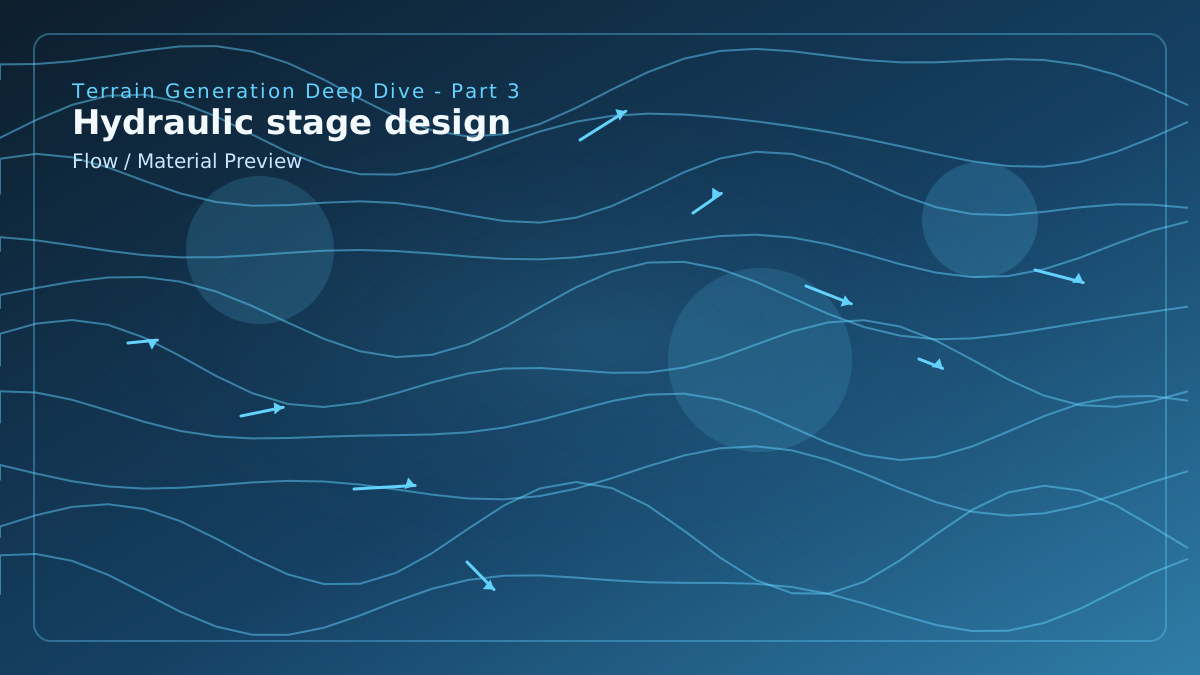
Hydraulic passes focus on carving and deposition dynamics. This creates channels, valleys, and transitions that are hard to fake with single-pass filters.
In practice, the key is controlling intensity and iteration count so erosion enriches structure instead of destroying designed map intent.
- Sediment transport gives valleys and basins believable accumulation patterns.
- Flow directionality helps align visual storytelling with map topology.
- Parameter clamps keep core strategic structures intact.
Thermal stage design and GPU acceleration
Thermal erosion targets slope stability. It redistributes material where gradients are too steep, reducing hard synthetic edges after macro shaping.
GPU compute acceleration makes these passes practical at higher resolutions, especially when iterating across multiple map variants.
- Slope-aware collapse improves ridge and cliff transitions.
- GPU paths reduce turnaround time for heavy generation workloads.
- CPU fallback paths preserve portability across runtime targets.
Next Steps
Terrain Generation Deep Dive
Part 3 of 6